A quarter to five on a Sunday morning, and the café on the corner of the park has only just rolled its shutter halfway up. A running group of eight stands waiting before a 30 km long run. Most order black phin coffee (Vietnamese drip-filter coffee), and a few have already tucked caffeinated gels (packets of carbohydrate in paste form, eaten during the run) into their shirt pockets. One woman pulls a bottle of dark red beetroot juice from her waist pack. The youngest in the group shakes a plastic bottle of powder bought online, the label printed in big letters with three words, caffeine, beta-alanine, creatine, next to a lightning bolt.
Every hand holds something meant to boost performance. But for long-distance running specifically, only two of these have meaningful data: caffeine and the nitrate in beetroot. The rest work elsewhere, in short efforts of a few dozen seconds to a few minutes or in strength sessions, a long way from three hours on the road.
A black coffee before the start
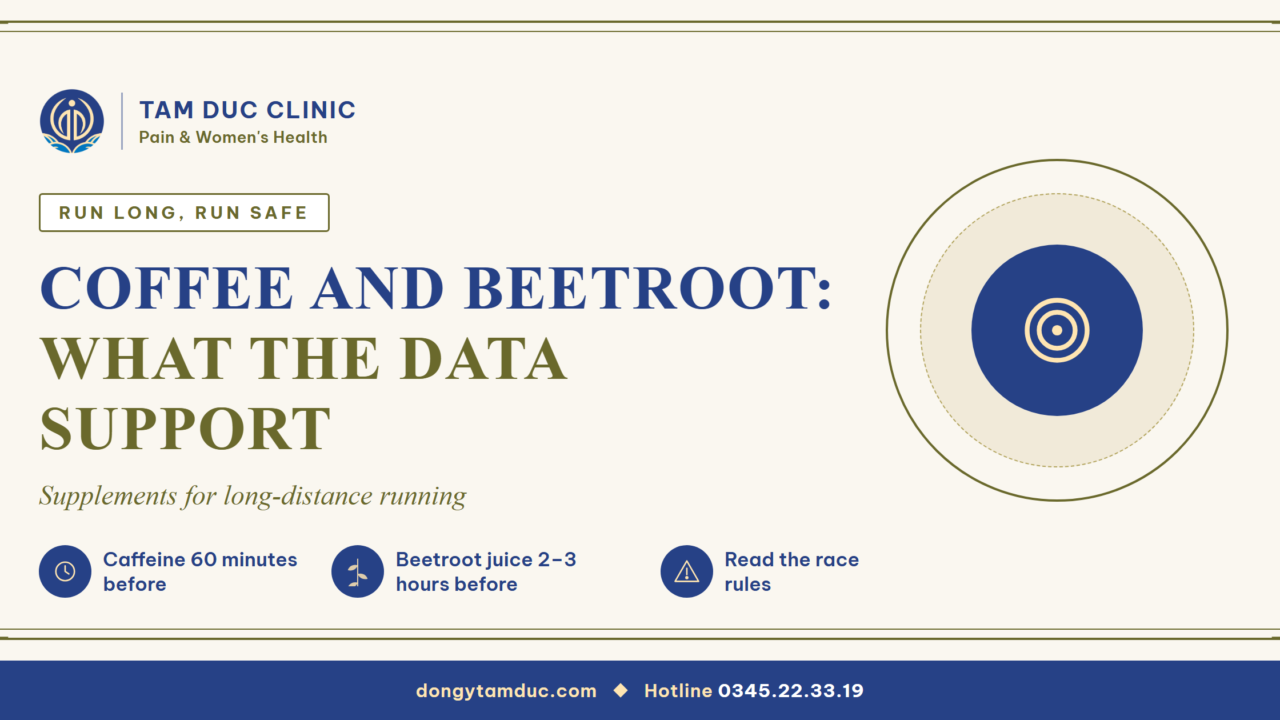
In this group, caffeine has the strongest evidence. The International Olympic Committee (IOC; Maughan et al., 2018) and the International Society of Sports Nutrition (ISSN; Guest et al., 2021) give the same dose in their consensus statements: 3–6 mg per kg of body weight, taken about 60 minutes before running.
So someone weighing 60 kg would take about 180–360 mg. Someone weighing 70 kg, 210–420 mg. A higher dose is not necessarily better. From 9 mg/kg upward (about 540 mg for a 60 kg person), reviews find no extra benefit, only more nausea, restlessness and anxiety, and poor sleep.
Two meta-analyses on running (Wang et al., 2022; Naulleau et al., 2022) show that time to exhaustion gets longer, with an effect size of about 0.39. That is the number researchers use to measure whether an effect is large or small, and 0.39 means a clear but not large benefit. In time trials over a set distance, which are closer to race day, the improvement is small. There are still few studies in women. In hot weather, performance rises by about 2.1%, but this figure is not statistically significant, meaning it is not yet certain enough to rule out chance. In a hot, humid country like ours, runners should keep that in mind, because the benefit of caffeine in the heat has not been firmly proven.
Among the things runners commonly use, a moderate dose of caffeine is one of the few with good evidence, on a par with eating carbohydrate according to running time and drinking to thirst.
Mid-run gels and the 200 mg mark
Not everyone does well with a strong coffee before the start. A low dose also works. Below 3 mg/kg, about 200 mg, taken before or during the run along with carbohydrate, still helps (Guest et al., 2021). Caffeinated gels print the number of mg right on the label, so taking them during the run along with your hourly carbohydrate is one way to split the dose.
The figure of 200 mg also matches a safety mark. The U.S. Food and Drug Administration (FDA) and the European Food Safety Authority (EFSA) are often cited for a mark of 200 mg per serving and 400 mg per day for healthy adults in general. A 60 kg person who picks the high end of the 3–6 mg/kg range (up to 360 mg) is already over the 200 mg mark for a single serving. So start at the low end, try it during long training runs, and only then think about increasing. As for the EFSA marks, we have only read news reports, not the original document.
You cannot measure the caffeine in a cup of phin coffee by eye. Every café uses a different bean, a different way of brewing, stronger or weaker. If you plan to use caffeine in a calculated way on race day, rely on something with the mg printed on the label, then add up the morning coffee, the gels and the cans of energy drink over the day.
Some people need to be more careful:
- If you are pregnant or breastfeeding, keep to no more than 200 mg per day from all sources combined (EFSA, 2015);
- If you have felt nauseous, restless or unable to sleep after coffee, that is already a sign the dose is too much for you;
- If you have a chronic illness or take medicines, ask your treating doctor before adding a pre-race dose;
- No one should use pure powdered caffeine, the form the FDA has warned about because of the risk of death.
The bottle of dark red juice
At our markets, beetroot mostly ends up in soups and stir-fries. A bottle of beetroot juice is a new habit that arrived with running groups. What runners are after in it is nitrate.
The dose studied is 5–9 mmol of nitrate, about 310–560 mg, taken 2–3 hours before running (Maughan et al., 2018; Gao et al., 2021; d’Unienville et al., 2021). The timing is quite different from caffeine. For a start at five in the morning, you would have to drink it at two or three in the morning, so for races with early starts this needs planning. Doubling the dose adds nothing: at 16.8 mmol, results were no better than at 8.4 mmol.
The benefit is small. Very well-trained people, with a VO₂max (a measure of cardiorespiratory endurance that many running watches display) of 65 mL/kg/min or more, see almost no benefit. In women it is not yet clear, because there are few data. Some people get digestive upset, so the juice also has to be tried out in training, like the gels; do not wait until race morning to drink it for the first time. To know how many mmol you are drinking, you need a product with the nitrate content on the label. Homemade juice cannot be measured.
The evidence for nitrate is one level thinner than for caffeine: it can be used, depending on the person. Recreational runners who have not trained to peak level have grounds for choosing it. The closer you get to the front of the field, the thinner the gain.
Nitrate is not prohibited. Leaney et al. (2022) did measure traces of higenamine in beetroot, a substance prohibited at all times on the list of the World Anti-Doping Agency (WADA), but at levels below 1% of the reporting threshold. The authors may have interests related to testing services, which we have not been able to verify. In our view, traces this small are not yet a worry with a glass of juice. They are only worth remembering so you do not believe that everything natural is automatically clean.
The tub of powder with a lightning bolt
The young runner’s plastic bottle has three things in it, and caffeine has been covered above. The other two, plus bicarbonate, which is often passed around in running groups, all have fairly clear data; the data just point in a different direction.
- Sodium bicarbonate, that is, the baking soda you use in the kitchen, works for efforts lasting from 30 seconds to 12 minutes. For continuous running, the meta-analysis by Miller et al. (2025) found an effect size of only 0.18, not statistically significant, while digestive upset occurred in 29.5% of users compared with 2.6% in the placebo group;
- Beta-alanine helps in efforts of 0.5–10 minutes (Saunders et al., 2017), and the IOC classes it as an option that can be used. The main side effect is paresthesia, a prickling feeling like ants crawling on the skin;
- Creatine does not improve endurance in trained people (Fernández-Landa et al., 2023), although it is safe at up to 30 g a day for 5 years in healthy people (Kreider et al., 2017).
Bicarbonate and beta-alanine help in bursts of effort lasting from half a minute to a few minutes, like the sprint finish of a short race. A 30 km long run has almost no phases like that. Creatine does not increase endurance. Bicarbonate also makes you pay the price mid-run, with nearly a third of users getting digestive upset.
To be fair, creatine has one exception worth mentioning. In people aged 60 and over doing resistance training (weights, strength work), creatine helps increase strength a little (Kreider et al., 2017). One could infer that middle-aged runners might also use it to hold on to muscle, but there is no randomized trial yet in runners of that age. If you use it, use it for strength sessions; race day does not need it.
The expensive bottle of ketone ester (a ketone supplement drink; ketones are substances the body can burn for energy instead of sugar) has not passed testing either. One 8-day randomized trial found no improvement in performance (Engelbrecht et al., 2026). Bicarbonate, beta-alanine, creatine (for endurance) and ketone ester all sit in the group not recommended for long-distance running.
Not prohibited, but still read the race rules
Caffeine is not a prohibited substance. WADA places it in the 2026 Monitoring Program, which means it is being watched. However, the rules of an individual race can be stricter than the general list. The QUARTZ program (a program that monitors athletes’ health and medicines) of the UTMB race (a major mountain trail race around the Mont Blanc massif in Europe), according to a 2021 news item, once banned all substances on the monitoring list in the 24 hours before the race, caffeine included. The race’s current policy page no longer mentions QUARTZ, so this was only a past rule. Even so, runners in races with doping control still need to read the rules of the exact race they are entering.
A tub of powder bought online is much riskier than a cup of coffee. Geyer et al. (2008) surveyed 634 dietary supplements bought over the two years 2001–2002 and found that about 15% contained prohibited substances not listed on the label. An athlete who is tested is responsible even for substances they did not know were there. Products with third-party certification (issued by an independent testing organization, not claimed by the manufacturer itself) reduce this risk, but do not remove it entirely.
Two cups of phin every morning and the peroneal muscles
Applied Kinesiology (AK, a way of testing muscle strength by hand to read the state of the body) is the clinic’s area of in-depth strength. The trials above answer the question of how far a substance helps runners in general. AK asks how your body is responding to that substance.
Take the example of a right ankle that keeps giving way in the second half of long trail runs (running on mountain and hill trails), in someone who has two cups of phin every morning plus caffeinated gels on the road. On muscle testing, the right peroneal muscles, the group that keeps the outer side of the ankle stable, are working below threshold, meaning they weaken when tested. The doctor gently pushes the outer edge of the foot inward, and the muscles cannot hold.
The peroneal group brings coffee to mind because of a note by Walther, author of the AK textbooks. Discussing nutrients for this muscle group, he advises avoiding foods rich in oxalic acid, and among the items he lists is caffeine, alongside cranberries and plums (Synopsis, p. 332–333). So the doctor puts a little of the coffee the person usually drinks on their tongue and retests the peroneal muscles. If the muscles get weaker, the cup of coffee becomes a lead to follow.
Walther also groups coffee, tea, cola and chocolate as stimulants that push the adrenal glands (small glands sitting on top of the kidneys that release hormones to help the body cope with stress) to work harder (p. 504). Gangemi, another AK author, looks at coffee from the angle of whether the body has enough water or not. He uses abdominal muscles and the quadriceps (front thigh muscle) that are testing strong as the test; if tasting a little caffeine makes these two muscles weak, the body may be taking in too much, along with mild dehydration that has not yet caused symptoms (ICAK 2009–2010, p. 157). For someone having two cups of phin plus gels during the run, the appointment therefore includes an extra question about how much water they drink on long runs.
That result tells you how this person’s body responds to their own cup of coffee at the time of the examination. Cutting out one cup or changing when they drink it is something to discuss afterward, while the mg for race day is still calculated by body weight, as at the start of this article. Beetroot also appears in the AK books, but as an extract of beet leaves, used for the popliteus, a small muscle at the back of the knee (Cuthbert, p. 24), and has nothing to do with the glass of juice before a race.
An appointment for an ankle that keeps giving way
At the clinic, the doctor first asks about the things that cannot wait. A pounding heart, chest pain, dizziness or fainting during a run needs to be examined right away; do not just blame the cup of coffee. Only then comes the list of everything you take on a long-run day: the morning coffee, gels, juice, the tub of powder, supplement tablets.
For the right ankle in the example, the cup of phin is only one of several leads. The doctor also asks about sleep and about some ankle sprain from long ago. If the signals from the old ankle injury are still misreporting, the doctor re-stimulates that signal pathway and taps the tendon reflexes, along with a few gentle movements at the ankle joint. Then the runner stands on the right leg to retest the peroneal muscles. The clinic tests in a standing position like this, not on a treadmill.
Some people need a third cup just to get through the morning, sleep fitfully, and feel tired on every run. In the clinic’s experience, it is better then to look at sleep and training load before discussing caffeine doses. Once the necessary tests have come back, and the four examinations (the four ways traditional medicine examines: looking, listening and smelling, asking, and taking the pulse) still show a clear traditional medicine pattern, the doctor may prescribe a decoction in ready-to-drink 50 ml pouches matched to that pattern. If the coming race season has doping control, the doctor needs to know in advance in order to leave out any herbs that risk causing a positive doping test.
Next Sunday, the running group will stand in front of the half-raised shutter again. The black phin coffee can still be ordered, as long as the dose is moderate and has been tried out in training. The juice is better opened two or three hours earlier, while the whole group is still at home. The lightning-bolt powder has no reason yet to come along with him on a 30 km run.
Appointments with Dr. Dinh Ngoc Duc (MD, MSc in Traditional Medicine) are for people who want to know whether their morning coffee is helping or making things harder for their body, or who are planning to add a substance for the coming race season. Book a consultation.
Worth keeping
- Caffeine for endurance running: 3–6 mg per kg of body weight, about 60 minutes before running; start at the low end;
- A dose below 3 mg/kg, about 200 mg, taken with carbohydrate during the run still helps; from 9 mg/kg it adds nothing;
- Add up all caffeine sources over the day and stay within the 400 mg mark; if pregnant or breastfeeding, no more than 200 mg;
- Beetroot nitrate: 5–9 mmol (310–560 mg), taken 2–3 hours before, tried out first in training;
- To run long distances better, bicarbonate, beta-alanine and creatine are not in the group worth using;
- Do not use pure powdered caffeine;
- For races with doping control, read the race rules and only use products with third-party certification.
References
Sources in English
- Cuthbert S. 2013. Applied Kinesiology: Clinical Techniques for Lower Body Dysfunctions. Gangasas. p. 24.
- d’Unienville NMA, Blake HT, Coates AM, Hill AM, Nelson MJ, Buckley JD. 2021. Effect of food sources of nitrate, polyphenols, L-arginine and L-citrulline on endurance exercise performance: a systematic review and meta-analysis of randomised controlled trials. J Int Soc Sports Nutr. 18(1):76. doi:10.1186/s12970-021-00472-y. PMID: 34965876.
- EFSA Panel on Dietetic Products, Nutrition and Allergies (NDA). 2015. Scientific Opinion on the safety of caffeine. EFSA Journal. 13(5):4102.
- Engelbrecht L, Lauriks W, Robberechts R, Stalmans M, Ramaekers M, Terblanche E, et al. 2026. Ketone Ester Intake Did Not Improve Performance, Neither Cognitive Function or Sleep, During an 8-Day Simulated Cycling Race. Med Sci Sports Exerc. doi:10.1249/MSS.0000000000004119. PMID: 42658808.
- Fernández-Landa J, Santibañez-Gutierrez A, Todorovic N, Stajer V, Ostojic SM. 2023. Effects of Creatine Monohydrate on Endurance Performance in a Trained Population: A Systematic Review and Meta-analysis. Sports Med. 53(5):1017-1027. doi:10.1007/s40279-023-01823-2. PMID: 36877404.
- Gangemi SC. 2009–2010. Advanced (De)Hydration Assessment: When Water Alone is Not Enough. ICAK-USA Collected Papers 2009–2010. p. 157.
- Gao C, Gupta S, Adli T, Hou W, Coolsaet R, Hayes A, et al. 2021. The effects of dietary nitrate supplementation on endurance exercise performance and cardiorespiratory measures in healthy adults: a systematic review and meta-analysis. J Int Soc Sports Nutr. 18(1):55. doi:10.1186/s12970-021-00450-4. PMID: 34243756.
- Geyer H, Parr MK, Koehler K, Mareck U, Schänzer W, Thevis M. 2008. Nutritional supplements cross-contaminated and faked with doping substances. J Mass Spectrom. 43(7):892-902. doi:10.1002/jms.1452. PMID: 18563865.
- Guest NS, VanDusseldorp TA, Nelson MT, Grgic J, Schoenfeld BJ, Jenkins NDM, et al. 2021. International society of sports nutrition position stand: caffeine and exercise performance. J Int Soc Sports Nutr. 18(1):1. doi:10.1186/s12970-020-00383-4. PMID: 33388079.
- Kreider RB, Kalman DS, Antonio J, Ziegenfuss TN, Wildman R, Collins R, et al. 2017. International Society of Sports Nutrition position stand: safety and efficacy of creatine supplementation in exercise, sport, and medicine. J Int Soc Sports Nutr. 14:18. doi:10.1186/s12970-017-0173-z. PMID: 28615996.
- Leaney AE, Heath J, Midforth E, Beck P, Brown P, Mawson DH. 2022. Presence of higenamine in beetroot containing ‘foodstuffs’ and the implication for WADA-relevant anti-doping testing. Drug Test Anal. 2023;15(2):173-180. doi:10.1002/dta.3383. PMID: 36218291.
- Maughan RJ, Burke LM, Dvorak J, Larson-Meyer DE, Peeling P, Phillips SM, et al. 2018. IOC consensus statement: dietary supplements and the high-performance athlete. Br J Sports Med. 52(7):439-455. doi:10.1136/bjsports-2018-099027. PMID: 29540367.
- Miller LE, Bhattacharyya R, Katz SJ, Bhattacharyya M, Herbert WG. 2025. Negligible benefit of oral single-dose sodium bicarbonate on continuous running performance: systematic review with meta-analysis of randomized, double-blind, placebo-controlled trials. J Int Soc Sports Nutr. 22(1):2538606. doi:10.1080/15502783.2025.2538606. PMID: 41416636.
- Naulleau C, Jeker D, Pancrate T, Claveau P, Deshayes TA, Burke LM, et al. 2022. Effect of Pre-Exercise Caffeine Intake on Endurance Performance and Core Temperature Regulation During Exercise in the Heat: A Systematic Review with Meta-Analysis. Sports Med. 52(10):2431-2445. doi:10.1007/s40279-022-01692-1. PMID: 35616851.
- Saunders B, Elliott-Sale K, Artioli GG, Swinton PA, Dolan E, Roschel H, et al. 2017. β-alanine supplementation to improve exercise capacity and performance: a systematic review and meta-analysis. Br J Sports Med. 51(8):658-669. doi:10.1136/bjsports-2016-096396. PMID: 27797728.
- U.S. Food and Drug Administration (FDA). Pure and Highly Concentrated Caffeine [Internet]. Available from: fda.gov.
- U.S. Food and Drug Administration (FDA). Spilling the Beans: How Much Caffeine Is Too Much? [Internet]. Available from: fda.gov.
- UTMB. 2021 Sep 20. Result UTMB health policy (QUARTZ program) [Internet]. Available from: montblanc.utmb.world/news/Result-UTMB-health-policy.
- Walther DS. 2000. Applied Kinesiology: Synopsis. 2nd ed. Pueblo (CO): Systems DC. p. 332–333, 504.
- Wang Z, Qiu B, Gao J, Del Coso J. 2022. Effects of Caffeine Intake on Endurance Running Performance and Time to Exhaustion: A Systematic Review and Meta-Analysis. Nutrients. 15(1). doi:10.3390/nu15010148. PMID: 36615805.
- World Anti-Doping Agency (WADA). 2026a. The 2026 Monitoring Program.
- World Anti-Doping Agency (WADA). 2026b. The 2026 Prohibited List (in force 1 January 2026). Available from: https://www.wada-ama.org/sites/default/files/2025-09/2026list_en_final_clean_september_2025.pdf.