The finish arch of the 42 km trail race (running on mountain and hill trails) stands on a grassy field at the foot of the pass. You run through it at nearly one in the afternoon, after a final ten kilometers that were almost all downhill. A volunteer hangs a medal around your neck and presses a bottle of water and half a banana into your hand. You pose for photos with your group, take off your race bib, then climb onto the coach back to the city. The ride takes four hours, and you sleep through most of it. By the time you get home it is dark, your body feels like it is falling apart, and you only manage to make a packet of instant noodles before going back to sleep.
Two days later, the front of your thighs aches every time you walk down the stairs, which you are used to by now. What puzzles you is the Thursday run the following week. An easy five-kilometer run around the lake, yet your legs feel like lead, and by the third kilometer you already want to walk.
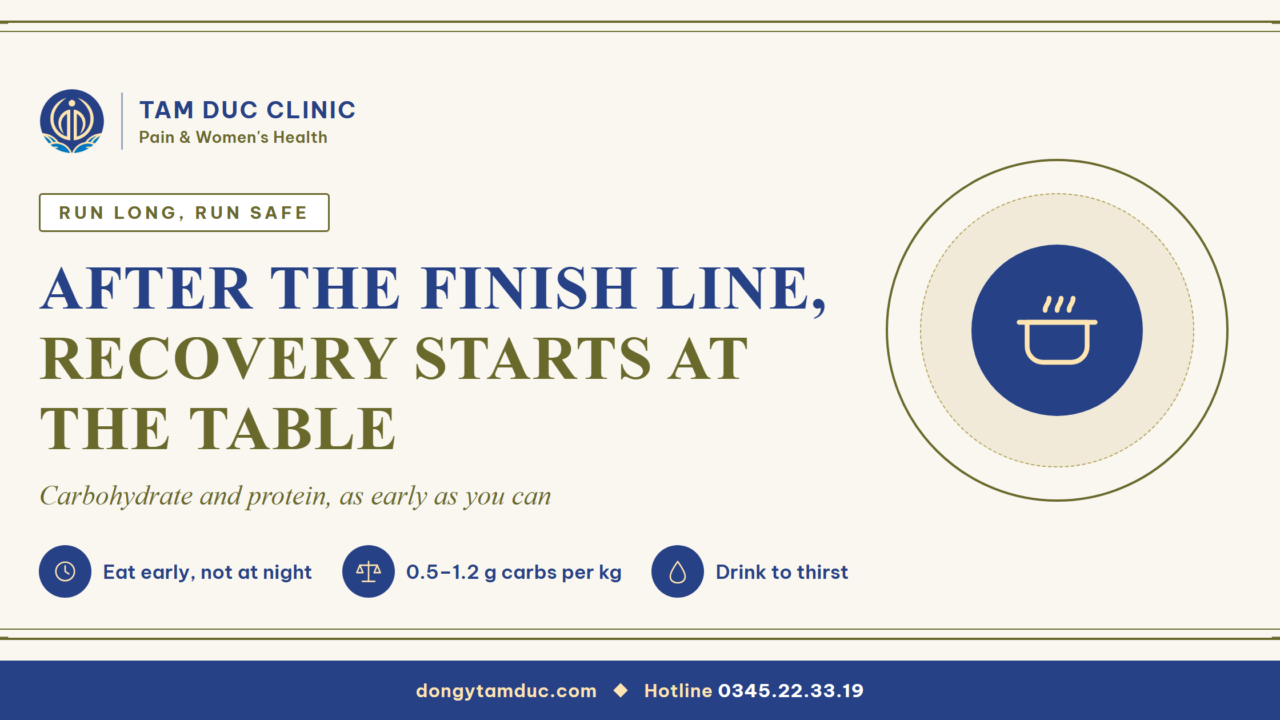
The ache in your thighs will fade on its own. The gap lies in the six or seven hours between crossing the finish arch and making those noodles, right when your muscles had just finished the hardest work of the season. Recovery after a race starts with a meal, and that meal needs both carbohydrate and protein.
Half a banana and a packet of noodles
After several hours of running, the sugar stores in your muscles and liver, called glycogen, have run down a lot. The thigh muscle fibers that have just been braking your body all the way down the descent are tired, with small areas of damage, and need raw material for repair. Carbohydrate refills the sugar stores. Protein is the material muscle uses to repair itself.
The food at the finish arch has a little carbohydrate and almost no protein. The bowl of noodles in the evening comes far too late, and it is all carbohydrate as well. Even together, the two do not make a recovery meal.
The first plate of rice after the finish line
For the meal right after a run, the International Society of Sports Nutrition (ISSN; Kerksick and colleagues, 2017) and the book Performance Nutrition by Austin and Seebohar give the same range: 0.5–1.2 g of carbohydrate per kg of body weight, with 10–25 g of protein. So a person weighing 60 kg needs about 30–72 g of carbohydrate, plus 10–25 g of protein.
Turning those grams into familiar food is not hard. Carbohydrate is in rice, sticky rice (xoi), rice noodles (bun), pho, bread (banh mi) and potatoes. Protein is in eggs, meat, fish, tofu (dau phu), milk and yogurt. A carton of milk, a pot of yogurt or a packet of biscuits has the grams printed on the label, so you just add them up. A bowl of pho or a plate of broken rice (com tam) has no label, so you can only estimate. A normal meal-sized serving of rice, rice noodles or bread, plus a portion of egg, meat, fish or tofu, covers both. Right there in the race village, simply adding a carton of milk next to the banana makes the meal much better.
These two figures are recommendations from a professional society and a sports nutrition book, that is, the distilled judgment of experts, not the result of a trial run specifically on recreational runners here in Vietnam. We have also not seen any source that sets a deadline in minutes for people who can rest the whole day after a race. We give only one easy-to-remember piece of advice. Eat as soon as your stomach can take food, and do not let the meal with carbohydrate and protein slip all the way to the evening.
As for water, drink to thirst, not to a schedule. The bowl of soup in a family meal or the broth of a bowl of pho is already salty, so the meal itself is also a chance to replace salt. If you weigh yourself after the run and find you really have lost weight, replace fluid slowly, with something a little salty. Stop once you are no longer thirsty; forcing down large amounts after a race does not speed recovery, and some people even develop nausea, headache and confusion.
Another stage in four hours
Some people do not get the whole day off as you do. They are running multi-stage races with a short stage still to come in the afternoon, or training twice a day. When the next session comes within four hours, the ISSN switches to an hourly amount. Each hour, eat about 1.2 g of carbohydrate per kg of body weight, or 0.8 g of carbohydrate with 0.2–0.4 g of protein per kg.
For a 60 kg person, that is about 72 g of carbohydrate per hour, or 48 g of carbohydrate plus 12–24 g of protein per hour. Eating that much between two stages is not easy when your stomach is still queasy from the first. In our view, the option with protein is easier to follow for people who are sick of sweet things, because there is less carbohydrate to eat. Food between stages should also be something your stomach is already used to from training.
As for you, who slept through the coach ride and have no stage at all the following week, you just need a plate of rice with enough carbohydrate and protein, as long as it comes early.
Protein spread through the day
The meal after the finish line is only the first. Across the whole day, the ISSN advises people who train to eat 1.4–2.0 g of protein per kg of body weight, split into servings of 20–40 g, 3–4 hours apart. Ultra runners (running distances longer than a marathon) need about 1.6 g of protein per kg of body weight, possibly up to 2.5 g/kg (Jäger and colleagues, 2017; Tiller and colleagues, 2019). So a 60 kg person needs about 84–120 g of protein a day, which means four or five meals or snacks with protein.
Everyday Vietnamese family meals tend to pile the protein into the plate of meat or fish at dinner, while breakfast is just a bowl of plain sticky rice or a plain bread roll. To spread it out, add an egg or a carton of milk at breakfast, and have a pot of yogurt or a glass of soy milk as an afternoon snack. The ISSN also mentions 30–40 g of casein, the main protein in milk, eaten before sleep. If you use protein powder for convenience, read the label carefully; runners in races with doping control should choose a product with third-party certification, that is, from a testing body independent of the manufacturer.
A hot meal for someone back from a long journey
Many families still keep the custom of serving a hot meal first to someone back from a long journey, with the stories saved for later. That custom fits what sports nutrition advises. After a race, though, what tends to push ahead of the meal is the coach ride, the photo session and a deep, heavy sleep.
Traditional medicine calls the muscles the flesh (肌肉, jī ròu) and assigns them to the Spleen, the organ system in charge of digestion (Basic Theory of Chinese Medicine, 中医基础理论 / 中醫基礎理論, p. 239), so after a long day of exertion, the practitioner also looks at the Spleen and Stomach. If a few days after the race you still have a poor appetite, feel listless without end, look pale and your legs are slow to recover, the doctor first orders a complete blood count and ferritin (a measure of the body’s stored iron). Anemia or iron deficiency must be corrected by replacing exactly what is missing. Only if the blood results are fine and the four examinations (looking, listening, asking and taking the pulse in traditional medicine) show a pattern of qi and blood deficiency (气血虚 / 氣血虛, qì xuè xū) after a period of exertion may the doctor prescribe a decoction in ready-to-drink 50 ml pouches aimed at supplementing qi and blood, cooked separately according to each person’s pattern.
No trial has shown that the pouches make muscles recover faster after a race. They come after the meal and cannot replace it. If you compete in races with doping tests, remember to tell the doctor, because a few traditional Chinese herbs contain substances on the prohibited list.
Aching thighs after ten kilometers downhill
The ache in the front of your thighs two days after the race is delayed-onset muscle soreness, most common after a long descent; it fades on its own, and the next downhill run is usually easier (Brunnstrom; Tallis and colleagues, 2024). Anti-inflammatory painkillers hardly reduce it at all (Travell and Simons). But when the muscles are swollen and severely painful, the urine is as dark as cola or red, and you pass little urine, think of rhabdomyolysis (widespread damage to muscle tissue) and get muscle enzymes and kidney function tested the same day (Jameson and colleagues, 2018; Papadakis and colleagues, 2022).
A few products advertised for “muscle pain relief” have data, but small. Pooling studies, tart cherry juice reduced muscle soreness and helped strength return faster (Hill and colleagues, 2021). Curcumin from turmeric slightly reduced muscle enzymes and pain (Fang and colleagues, 2020). Fish oil omega-3 lowered the muscle enzymes CK and LDH (two blood markers that rise when muscle is damaged), while the reduction in pain was too small for users to notice (Xin and colleagues, 2021; Lv and colleagues, 2020). The Australian Institute of Sport (AIS) puts all three in Group B, meaning emerging or still mixed evidence, worth considering only in specific situations. None of the three can replace the plate of rice after the finish line.
An ice bath is not needed. Joyce and Lewindon (2016) also note that immersing the whole body in ice water can shift blood suddenly, pushing up central blood pressure (the pressure in the large vessels near the heart) and raising the risk of a cardiovascular event.
The glutes only give themselves away after a set of jumps
The heavy legs of that Thursday run around the lake have a whole procedure of their own in Applied Kinesiology (AK, a method of testing muscle strength by hand to read the state of the body), the method our clinic practices in depth. It was put together by Gangemi, an author with the International College of Applied Kinesiology (ICAK) who works extensively with endurance athletes.
Suppose you come to the clinic on the Friday of that week. The ache in your thighs has gone, leaving only a feeling that your legs have no power. On muscle testing, both large gluteal muscles work below threshold, meaning they weaken on muscle testing: a light push from the doctor and the leg cannot hold its position. One after another, the doctor places on your tongue a little non-hydrolyzed whey protein (protein from milk that has not been broken down in advance), a little BCAA (the three branched-chain amino acids), and then a little maltodextrin, a form of carbohydrate. After each one, the glutes are tested again. All three times, the muscles stay the same.
Gangemi explains why this step often shows nothing. Most athletes recover fairly quickly after a bout of exhaustion. By the time they are sitting in the clinic, the muscle still tests weak but is already on the way back, because the body is drawing on its glycogen stores, and above all on its protein sources, to repair itself quickly (ICAK 2010–2011, p. 131–132). To find out what the muscle is short of, you have to tire it further. The testing hand cannot measure how much more tired the muscle has become, because it was already weak, but a muscle that has been tired further responds differently when you taste something. You do deep squats or jump continuously right on the clinic floor until the glutes are at least about 80 % fatigued, then immediately taste the same three things again (p. 133).
This time, as soon as the whey touches your tongue, both gluteal muscles become strong and hold against the test. Gangemi reads that result as the glycogen stores being empty and the body switching to protein as fuel. He sees glycogen depletion and protein deficiency as the two main factors that make athletes tire early and perform poorly. If there were still enough glycogen, the body would not have had to break down muscle protein to burn (p. 132). Maltodextrin still changes nothing. Gangemi himself notes this: in theory these people are short of glycogen, yet he has never seen anyone strengthen with carbohydrate at this step (p. 133).
The next step in his procedure is to review the diet, especially the amounts of protein and carbohydrate, and then the training log, looking at intensity and number of sessions (p. 133). In this hypothetical case, the test leads straight back to the afternoon of the race, when your stomach held only half a banana. It shows what the body is short of. How many grams per meal is not something AK can set; that still follows the ISSN amounts for the first meal and for the whole day. The doctor retests the glutes while you stand on one leg and while you step up onto a high step, not on a treadmill.
A muscle tired from running out of fuel is also different from a pulled muscle. A sudden sharp pain at one point in the back of the thigh, sometimes with bruising, is a muscle strain or tear. In this case, Bandy (ICAK proceedings, Winter 1980) advises icing in twenty-minute rounds and waiting 24 hours for a strain and 48 hours for a tear with bruising before treating with AK. He believed a muscle is only pulled when it is “switched off” at that moment, that is, not activated enough by the nerves, so the first task is to find out why it switched off (p. 12).
When to see a doctor
Get seen the same day if, after a race, you have:
- Urine as dark as cola or red, severely swollen and painful muscles, passing little urine;
- Nausea, headache or confusion after drinking a lot of water beforehand, and in that case, do not drink any more.
Make an appointment if the thigh ache has not faded after ten days, if after every race you need a whole week before you can run easily again, or if you have a poor appetite and lasting tiredness after the race season.
At the next race, your bag at the race-village drop-off already holds an egg banh mi and a carton of milk. On the coach, you finish eating before you tilt your seat back to sleep. Once you are home, the evening noodles are just your second meal.
If you eat like this and your legs still feel heavy all week after every race, book an appointment with Dr. Dinh Ngoc Duc (MD, MSc in Traditional Medicine). The visit starts with what you ate from crossing the finish line until going to bed; any blood tests that are needed come first, and only then does the doctor test your glutes and thigh muscles, including after a short set of jumps. Book a consultation.
Worth keeping
- Leave one carbohydrate item and one protein item in your bag at the race-village drop-off, such as an egg banh mi and a carton of milk;
- First meal after the finish line: 0.5–1.2 g of carbohydrate per kg of body weight with 10–25 g of protein; for a 60 kg person, about 30–72 g of carbohydrate;
- If you run again within four hours, eat by the hour: each hour, about 1.2 g of carbohydrate per kg, or 0.8 g of carbohydrate with 0.2–0.4 g of protein per kg;
- Across the day, eat 1.4–2.0 g of protein per kg, in servings of 20–40 g, 3–4 hours apart;
- Drink to thirst, and only replace extra fluid if the scale shows a real loss, with something a little salty;
- Aching thighs after a descent fade on their own, with no need for anti-inflammatory painkillers or an ice bath;
- Urine as dark as cola, or severely swollen and painful muscles after a race: see a doctor the same day.
References
Sources in English
- Austin K, Seebohar B. 2011. Performance Nutrition: Applying the Science of Nutrient Timing. Champaign (IL): Human Kinetics. p. 93–95, 112.
- Australian Institute of Sport (AIS). AIS Sports Supplement Framework (Groups A–D).
- Bandy JVN. 1980. Rehabilitation of Muscle Pulls. ICAK Collected Papers, Winter 1980. p. 12.
- Fang W, Nasir Y. 2020. The effect of curcumin supplementation on recovery following exercise-induced muscle damage and delayed-onset muscle soreness: A systematic review and meta-analysis of randomized controlled trials. Phytother Res. 2021;35(4):1768-1781. doi:10.1002/ptr.6912. PMID: 33174301.
- Gangemi SC. 2010–2011. Enhancing Athletic Performance by Predicting Fatigue and Preventing Muscle Failure. ICAK-USA Collected Papers 2010–2011. p. 129–134.
- Hill JA, Keane KM, Quinlan R, Howatson G. 2021. Tart Cherry Supplementation and Recovery From Strenuous Exercise: A Systematic Review and Meta-Analysis. Int J Sport Nutr Exerc Metab. 31(2):154-167. doi:10.1123/ijsnem.2020-0145. PMID: 33440334.
- Houglum PA, Bertoti DB. Brunnstrom’s Clinical Kinesiology. p. 182, 186.
- Jäger R, Kerksick CM, Campbell BI, Cribb PJ, Wells SD, Skwiat TM, et al. 2017. International Society of Sports Nutrition Position Stand: protein and exercise. J Int Soc Sports Nutr. 14:20. doi:10.1186/s12970-017-0177-8. PMID: 28642676.
- Jameson JL, Fauci AS, Kasper DL, Hauser SL, Longo DL, Loscalzo J, editors. 2018. Harrison’s Principles of Internal Medicine. 20th ed. New York: McGraw-Hill Education. p. 2149, 3286, 3391.
- Joyce D, Lewindon D, editors. 2016. Sports Injury Prevention and Rehabilitation: Integrating Medicine and Science for Performance Solutions. London: Routledge. p. 418.
- Kerksick CM, Arent S, Schoenfeld BJ, Stout JR, Campbell B, Wilborn CD, et al. 2017. International society of sports nutrition position stand: nutrient timing. J Int Soc Sports Nutr. 14:33. doi:10.1186/s12970-017-0189-4. PMID: 28919842.
- Lv ZT, Zhang JM, Zhu WT. 2020. Omega-3 Polyunsaturated Fatty Acid Supplementation for Reducing Muscle Soreness after Eccentric Exercise: A Systematic Review and Meta-Analysis of Randomized Controlled Trials. Biomed Res Int. 2020:8062017. doi:10.1155/2020/8062017. PMID: 32382573.
- Papadakis MA, McPhee SJ, Rabow MW, et al., editors. 2022. CURRENT Medical Diagnosis and Treatment 2022. New York: McGraw-Hill. p. 536, 870.
- Tallis J, McMorrow C, Shelley SP, Eustace SJ. 2024. Repeated Bout Effect of Downhill Running on Physiological Markers of Effort and Post Exercise Perception of Soreness in Trained Female Distance Runners. Sports (Basel). 12(6). doi:10.3390/sports12060169. PMID: 38921863.
- Tiller NB, Roberts JD, Beasley L, Chapman S, Pinto JM, Smith L, et al. 2019. International Society of Sports Nutrition Position Stand: nutritional considerations for single-stage ultra-marathon training and racing. J Int Soc Sports Nutr. 16(1):50. doi:10.1186/s12970-019-0312-9. PMID: 31699159.
- Travell JG, Simons DG. 1992. Myofascial Pain and Dysfunction: The Trigger Point Manual. Vol. 2: The Lower Extremities. Baltimore (MD): Williams & Wilkins. p. 571.
- Xin G, Eshaghi H. 2021. Effect of omega-3 fatty acids supplementation on indirect blood markers of exercise-induced muscle damage: Systematic review and meta-analysis of randomized controlled trials. Food Sci Nutr. 9(11):6429-6442. doi:10.1002/fsn3.2598. PMID: 34760272.
Sources in Chinese
- 王新华, 主编. 中医药学高级丛书 · 中医基础理论. 第 239 页.