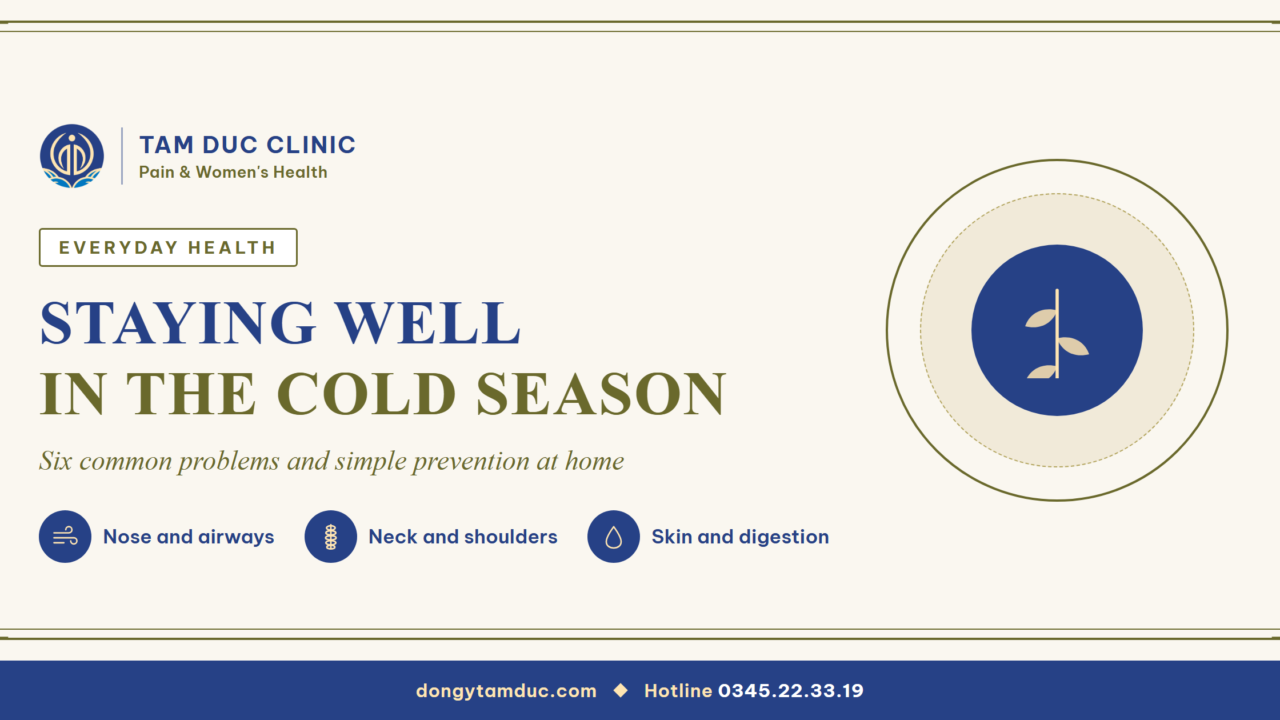
When the weather turns cold, it is also a sign that the festive season is coming again. It is a wonderful time to rest, relax and enjoy the fresh air. But as the weather changes and turns cold, many people more easily get conditions affecting the airways, the digestive tract, the skin, and the muscles, bones and joints. To enjoy a healthy, cheerful and happy festive season with your family, it helps to know which conditions are common in the cold season and the simple ways to prevent them that you can do yourself at home.
Allergic rhinitis
This is inflammation of the nose caused by an allergic reaction to irritants such as dust, cold weather, pollen, animal hair or mold. Common symptoms are sneezing, a runny nose, an itchy nose, a stuffy nose, watery eyes, headache and tiredness.
To prevent allergic rhinitis, you should:
- Keep your body warm.
- Wear a mask to keep your nose warm, and clean your nose regularly.
- Drink enough water, and eat plenty of fruit and vegetables rich in vitamins C and E and omega-3.
- If your symptoms are severe, see a doctor for treatment.
Common cold
This illness is usually caused by a virus. Common symptoms are a mild fever, cough, runny nose, headache, tiredness and chills.
To prevent colds, you should:
- Dress warmly and avoid sudden changes in temperature.
- Wash your hands often, and limit contact with people who are sick.
- Drink enough water, eat plenty of fruit and vegetables rich in vitamin C, and get enough rest.
- If your symptoms last a long time or are severe, see a doctor.
Neck pain from the cold
This is when the muscles of the neck and shoulders tighten up and cause pain, with limited movement when you turn your neck or head. It usually appears in the morning and is closely linked to the musculoskeletal system and the blood vessels of the neck and shoulders. The cause is pathogenic qi (邪气 / 邪氣, xié qì), namely wind (风 / 風, fēng), cold (寒, hán) and dampness (湿 / 濕, shī), invading the sinews, muscles and channels (jīng luò), which leads to qi stagnation and blood stasis (气滞血瘀 / 氣滯血瘀, qì zhì xuè yū).
To prevent neck pain from the cold, you should:
- Exercise in a way that suits you, choosing exercises within your ability and right for your own health.
- Keep a sensible work routine, and move around and take breaks when you sit for a long time.
- Keep a good posture when you sit to read, study or type, with your neck straight, and don’t bend your neck forward for too long.
- Eat a suitable diet with enough nutrients, and get some of the essential minerals and vitamins your body needs, such as calcium, potassium, and vitamins B, C and E.
- To treat neck pain from the cold, you can use methods such as electroacupuncture, filiform needle acupuncture, cupping, acupoint injection, moxibustion, and traditional herbal medicine.
Cold-induced itching (an allergy to cold temperatures, cold urticaria)
This is when the skin itches after contact with cold temperatures, cold air or cold water. The symptoms come from a histamine reaction in response to cold triggers, including a drop in temperature, cold air and cold water. Common symptoms are swollen, red and itchy skin, hives, pain, and a burning feeling in the areas exposed to the cold.
To prevent cold-induced itching, you should:
- Wear warm clothes, and add a hat, scarf and gloves so that your skin is exposed to the cold as little as possible.
- Check the water temperature before bathing or swimming. Bathe in warm water.
- Don’t drink iced or very cold drinks, and don’t eat cold foods such as ice cream or slushies.
- To treat cold-induced itching, you can take anti-allergy medicine as prescribed by a doctor, or use moisturizing and soothing creams for the skin.
Digestive upset from the cold
This is a condition whose common symptoms are cramping abdominal pain that comes and goes, a heavy, bloated stomach, indigestion, nausea and changes in bowel habits. It happens because in cold weather the low temperature makes blood circulate less well around the body; the digestive tract is affected too, and does not get enough blood to nourish it. Cold weather also reduces the contractions and movement of the intestines.
To prevent digestive upset from the cold, you should:
- Keep your body warm, especially your belly, neck and feet, whether you are out or at home.
- Eat sensibly: don’t eat too fast or too much at one meal, and cut down on fried and stir-fried food, very oily food and heavily spiced food.
- Avoid contact with cold water or cold air, such as bathing in cold water, drinking iced drinks, eating cold food, swimming, or going out in the rain.
Period pain from the cold
This is common in women during their period, when cold weather reduces blood flow to the uterus and makes the uterine muscle cramp. Period pain from the cold feels like waves of cramping pain in the lower abdomen, which may spread to the back or thighs, and gets worse with exposure to cold water or cold air.
To prevent period pain from the cold, you should:
- Keep your body warm, especially your belly, neck and feet, whether you are out or at home.
- Bathe in warm water, drink warm drinks or eat hot food, stay indoors and keep out of cold wind.
- Exercise regularly, especially gentle exercise that improves blood circulation, eases stress and strengthens your resistance, such as walking, yoga, deep breathing and stretching. Exercise in the morning or afternoon, not in the evening or on an empty stomach.
- Use ways of warming the belly, such as hot compresses, warming moxibustion, massage, acupressure, and traditional herbal medicine.
See a doctor right away if you have a high fever that will not go down, trouble breathing, chest pain, coughing up blood, repeated vomiting, or severe pain.
(Source: compiled)