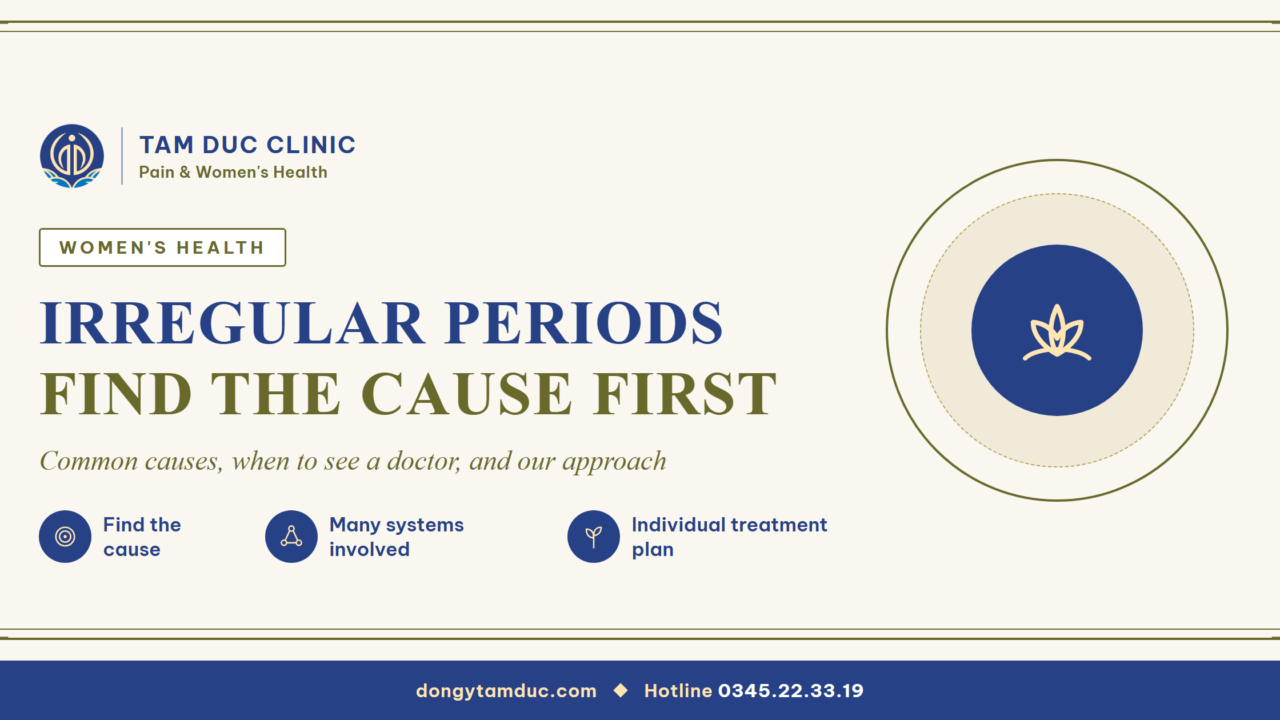
What are irregular periods?
Irregular periods are one of the most common reasons women come to see a doctor. They are not a single disease, though. They are a sign that the body may be having trouble in one or more of its regulating systems.
In a healthy woman, the menstrual cycle usually lasts 21–35 days, bleeding lasts about 3–7 days, and the amount of blood stays fairly steady from one cycle to the next.
Periods are considered irregular when any of the following happens:
- The cycle is shorter than 21 days or longer than 35 days,
- You get a period one month and skip the next.
- Your period comes late or stops altogether.
- You have a prolonged period, or bleeding between periods.
- The amount of blood is very light or very heavy.
- Your cycle changes unpredictably compared with before.
In some cases, especially during puberty or in the years leading up to menopause, the cycle can change because of normal physiological shifts. Even so, if the problem lasts at least 3 cycles in a row, or comes with other unusual symptoms, you should be examined to find the cause.
Why can periods become irregular?
The menstrual cycle is regulated by a complex network that includes:
- The brain (the hypothalamus)
- The pituitary gland
- The ovaries
- The uterus
- The thyroid gland
- The adrenal glands
- Metabolic processes
- The nervous system
- The body’s nutritional and energy status
So irregular periods do not only reflect a problem with the ovaries. They can also be linked to many other organs.
Common causes
-
Ovulation and hormonal disorders
This is the most common cause. It can be seen in:
- Polycystic ovary syndrome (PCOS)
- Reduced ovarian function
- High prolactin
- Disorders of the hypothalamus–pituitary axis
-
The years leading up to menopause
-
Long-term stress
Long-term stress can change how the hypothalamus works. The hypothalamus is the hormone control center in the brain.
When the body stays under constant stress, keeping the reproductive system running is no longer its top priority. This can lead to:
- Late periods
- Longer cycles
- Irregular ovulation
-
Periods stopping for a while
-
Not enough energy and nutrition
Extreme dieting, rapid weight loss or high-intensity training can leave the body without enough energy to keep the reproductive system working normally.
Even in people with a normal weight, a long-term energy shortfall can still affect the menstrual cycle.
-
Thyroid disease
Thyroid hormone plays an important role in regulating metabolism and hormonal activity.
Both an underactive and an overactive thyroid can cause:
- Infrequent periods
- Prolonged periods
- Light periods
-
Periods stopping altogether
-
Some other causes
- After giving birth.
- After stopping birth control pills.
- Long-term lack of sleep.
- Sudden weight gain or weight loss.
- Some medications.
- Chronic illnesses.
Why is it important to find the right cause?
In many cases, the goal of treatment is not simply to make the cycle regular again, but to identify what is disturbing the body’s regulation.
For example, two people with late periods may have completely different causes: one has polycystic ovary syndrome, while the other is under long-term stress or not getting enough energy. When the causes differ, the treatment differs too.
That is why a thorough, all-round examination matters before choosing a treatment.
The role of traditional medicine in treating irregular periods
Traditional medicine sees irregular periods as a sign of imbalance in how the whole body is working, rather than focusing only on the reproductive organs.
During the examination, the doctor looks at many factors, such as:
- Your menstrual cycle.
- What your menstrual blood looks like.
- How much you bleed
- Premenstrual symptoms
- Period pain
- Your stress level
- Your general constitution.
- Accompanying symptoms in the rest of the body, such as sleep and digestion…
From there, the doctor builds a treatment plan that suits each person. Depending on the case, treatment may include traditional herbal medicine, Applied Kinesiology, or a combination with changes to daily habits.
The goal is not only to improve the menstrual cycle but also to restore the body’s balance and improve your overall health.
What role does Applied Kinesiology play?
Applied Kinesiology (AK) is a method of functional assessment that some doctors use as a supporting tool during the examination, alongside taking your medical history, a physical examination and any necessary tests.
By testing muscle function together with assessing your general condition, AK can help identify functional factors that may be affecting the body, such as:
- Stress on the nervous system.
- How well the body’s functional systems work together.
- Some nutritional or metabolic factors that need further assessment.
- Problems with posture or movement that may affect the body.
AK does not replace the diagnostic methods of modern medicine, and it is not used to identify organic disease (disease with a physical cause that tests can show). Its role is to add functional information, so the doctor has a fuller picture when building a care plan for each person.
Our approach to treatment at the clinic
For someone with irregular periods, what matters is not only regulating the cycle but also finding the cause and the factors that are affecting the body’s ability to regulate itself.
Depending on the case, the examination and treatment may include:
- Taking your medical history and a physical examination, combined with the four examinations of traditional medicine (looking, listening and smelling, asking, and taking the pulse).
- Ordering tests or an ultrasound when needed, to support the diagnosis and rule out organic disease.
- Assessing factors that can affect the menstrual cycle, such as nutrition, sleep, stress level and lifestyle.
- Adding a functional assessment of the nervous system with Applied Kinesiology, to help identify functional factors that may be affecting the body’s ability to regulate itself.
- Building an individual treatment plan that fits the cause and the condition of each person.
- Guidance on adjusting daily habits and nutrition, with regular follow-up to keep the results lasting.
When should you see a doctor?
You should see a doctor if you have any of the following signs:
- No period for 3 months or more (and you are not pregnant).
- Your cycle is always longer than 35 days or shorter than 21 days.
- A period that lasts longer than 7 days.
- Bleeding between periods more than once.
- Period pain that keeps getting worse.
- Irregular periods together with difficulty getting pregnant.
- A clear change in your cycle compared with before.
An early examination helps find the cause and choose the right treatment, and lowers the risk of missing a condition that needs medical care.
Frequently asked questions
Can irregular periods affect my chances of getting pregnant?
They can. If your periods are irregular because of an ovulation disorder, the chance of conceiving naturally may be lower. How much it is affected depends on the specific cause.
Do irregular periods need medication right away?
Not every case needs medication. What matters is finding the cause before choosing the right treatment.
Can traditional medicine be combined with Western medicine?
In many cases, the two can be combined if there is a medical reason to do so and a doctor is monitoring your care.
Conclusion
Irregular periods are a sign that the body may be having trouble regulating its hormones, its metabolism or its reproductive function. So treatment aims not only to make the cycle regular but, more importantly, to identify and deal with the cause.
Combining modern medicine, traditional medicine and functional assessment methods such as Applied Kinesiology can help the doctor build an individual care plan aimed at improving your reproductive health and your health as a whole.
Understand your body, and take charge of your reproductive health!
You can reach us through:
- Phone: 0345.22.33.19 (Zalo, Telegram; our reception speaks Vietnamese, so a message works best)
- Facebook page: Tam Duc Clinic
- Website: https://www.dongytamduc.com/
- Address: 117/23A Nguyen Huu Canh, Thanh My Tay Ward, Ho Chi Minh City