After giving birth, women often hear that breast milk is the best nutrition for newborns and young children. Yet some new mothers find breastfeeding hard. This article answers one question: “How can I make more milk for my baby?”
Written by Dr. Pham Tran Dan Tam (MD, Specialist Level I in Traditional Medicine), a traditional medicine gynecologist at Tam Duc Clinic.
1. What is in breast milk
Breast milk is the nutrition best suited to the growth of newborns and young children. So what does it contain?
Breast milk is made up mainly of fat, protein, sugar, natural antibodies and vitamins.
- Breast milk provides nutrients MADE FOR YOUR BABY’S AGE that are easy to digest. It also provides immune factors that strengthen your baby’s resistance and lower the risk of conditions such as diarrhea, atopic dermatitis (allergic skin inflammation) and respiratory infections.
- The makeup and amount of breast milk change over the day and from one feed to the next. They are also affected by the mother’s diet and emotions, and by the baby’s age, health and need to feed. Within a single feed, the fat content rises toward the end, so your baby stays full longer after finishing the whole feed.
These qualities make breast milk special and different from formula.
2. Benefits of breastfeeding
Breast milk is different from formula, and it is the nutrition best suited to the growth of newborns and young children. Breastfeeding brings benefits to both mother and baby.
Benefits of breastfeeding for the baby
- Lower risk of hospital admission
- Lower risk of gastroenteritis (stomach and gut infections), respiratory infections, middle ear infections (otitis media), urinary tract infections and type 1 diabetes.
- Helps prevent obesity in early childhood, and allergies.
Benefits of breastfeeding for the mother
- Breastfeeding for 12 months lowers the mother’s risk of breast cancer by 4%; each year of breastfeeding lowers her risk of type 2 diabetes by 15%.
- Breastfeeding lowers the mother’s risk of ovarian cancer by about 24%.
- When a mother breastfeeds exclusively in the first 6 months, the rate of becoming pregnant is low. Breastfeeding only works as contraception when all three conditions are met: your baby is under 6 months old, your periods have not come back, and your baby is fully or nearly fully breastfed, often, day and night. If any one of these changes, you need another method; you can ask your doctor soon after the birth so you have one ready that suits breastfeeding, if you are not hoping for another baby yet.
- Breastfeeding for a total of 36 months or more lowers the mother’s risk of endometriosis by about 40%; the protective effect is strongest in the 5 years after the last birth.
3. How to make more milk for your baby
Some new mothers find breastfeeding hard and often search for answers to questions such as “I have little milk, what should I do?” and “How can I make more milk for my baby?”. Here are 7 principles to help you improve your milk supply:
- Prepare yourself emotionally before and after the birth: you can join a prenatal class to learn what to expect and to prepare emotionally for pregnancy, for the birth, and for the emotional and physical changes that come after it.
- Feel confident and relaxed: this makes it easier for your body to release milk
- Learn about the benefits of breastfeeding: when you understand them, you will feel more motivated, more confident and more persistent.
- A baby fed formula feels full and digests more slowly, so the baby breastfeeds less often, and this lowers the amount of milk your body makes. Topping up with formula can also shake your confidence that you have enough milk for your baby. So we do not encourage adding formula unless a doctor advises it.
- Breastfeed early: except where breastfeeding is not advised, in most cases you breastfeed within 30 minutes to 1 hour after birth. On the first day, your baby’s stomach is the size of a cherry and holds about 5 – 7 mL of milk.
- Breastfeed often: feed your baby on demand, and express the milk left in your breasts after each feed. This helps you make more milk for the next feed.
- Breastfeed the right way
Good breastfeeding positions: a good position keeps both you and your baby comfortable, so your baby latches on well and finishes the whole feed.
- Each breastfeeding position has its own advantages. If you had a cesarean birth, or have not yet recovered from the birth, the football hold or lying down to feed will be more comfortable and give you more rest while you breastfeed.
- Switching between positions helps drain milk from the lobules in different parts of the breast, which helps prevent a blocked milk duct or mastitis.
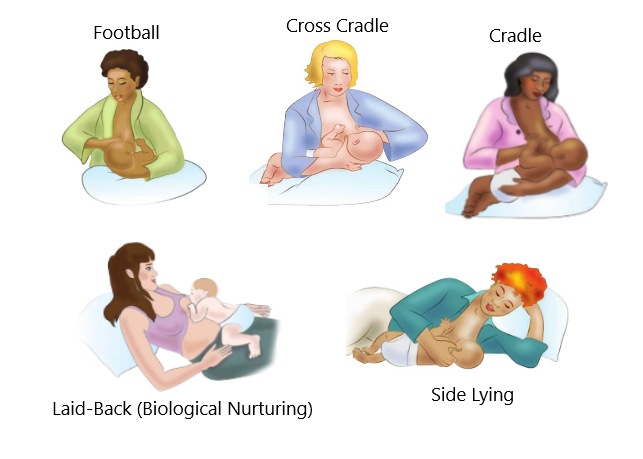
A good latch: when your baby latches on well, you will see these signs
- Your baby’s chin touches your breast
- Your baby’s mouth is wide open
- The lower lip is turned out
- More of the areola shows above your baby’s mouth than below it.
How much is enough: many mothers wonder “how much should a newborn drink?” or “how much should a 1-month-old drink?”. There is no single number that fits every baby. Still, on the first day your baby’s stomach is as small as a cherry and holds about 5 – 7 mL of milk. By 1 month, it is the size of a large egg and holds 80 – 150 mL. Some signs that your baby is getting enough breast milk:
- During the feed, your baby is relaxed and latched on well, and now and then you can hear gulping sounds. After the feed, your baby looks satisfied and lets go of the breast on their own.
- A baby who is getting enough usually sleeps peacefully for 2 – 3 hours and gains weight steadily.
For an in-person consultation, please call our HOTLINE: 0345.22.33.19 (reception speaks Vietnamese) or message our Fanpage https://www.facebook.com/pkdongytamduc
References used in this article:
- Jerome F. Strauss III, Robert L. Barbieri (2019), Yen & Jaffe’s Reproductive endocrinology, eighth edition, Elsevier.
- Gabbe, Nieby (2017), Obstetrics normal and problem pregnancies , seventh edition, Elsevier.
- F. Gary Cunningham (2014), Williams Obstetrics 24th edition, Mc Graw Hill Education.
- Collaborative Group on Hormonal Factors in Breast Cancer. Breast cancer and breastfeeding: collaborative reanalysis of individual data from 47 epidemiological studies in 30 countries. Lancet. 2002;360(9328):187-95. doi:10.1016/S0140-6736(02)09454-0.
- Stuebe AM, Rich-Edwards JW, Willett WC, Manson JE, Michels KB. Duration of lactation and incidence of type 2 diabetes. JAMA. 2005;294(20):2601-10. doi:10.1001/jama.294.20.2601.
- Babic A, Sasamoto N, Rosner BA, et al. Association between breastfeeding and ovarian cancer risk. JAMA Oncol. 2020;6(6):e200421. doi:10.1001/jamaoncol.2020.0421.
- Farland LV, Eliassen AH, Tamimi RM, Spiegelman D, Michels KB, Missmer SA. History of breast feeding and risk of incident endometriosis: prospective cohort study. BMJ. 2017;358:j3778. doi:10.1136/bmj.j3778.