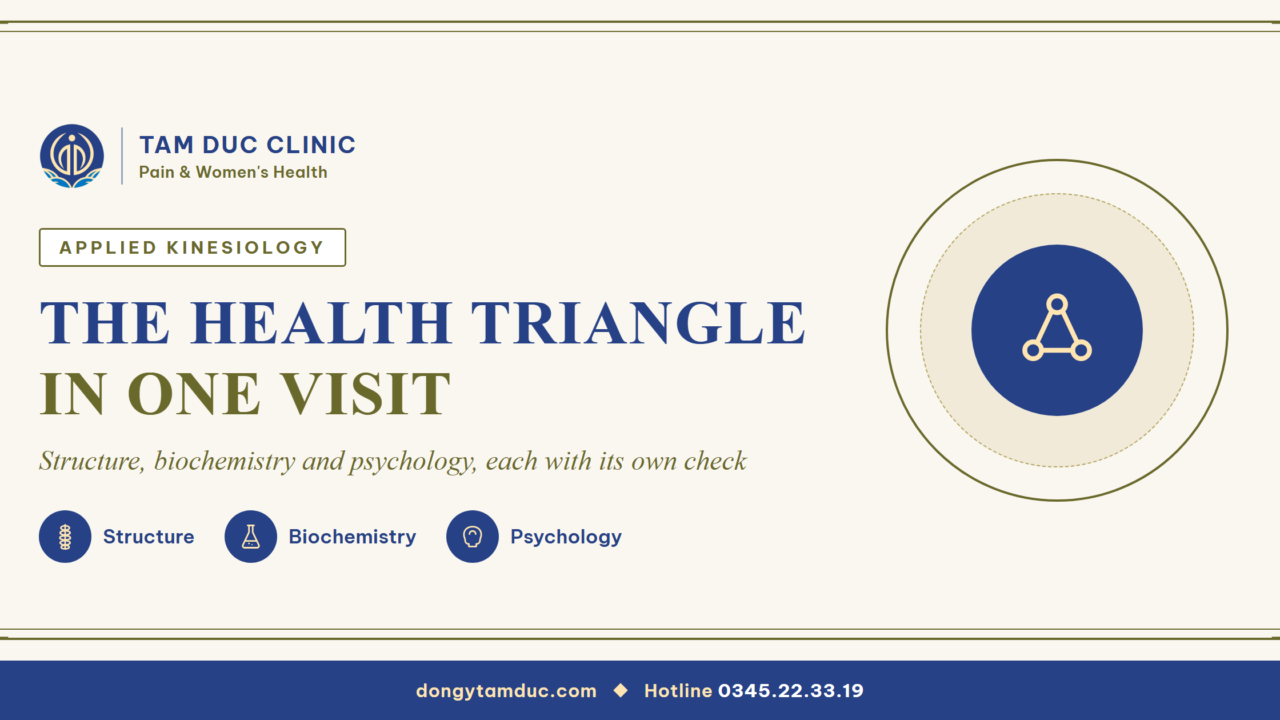
Two people can write the same line on their intake form: headaches in the afternoon, for a few months now. The first sits at a computer from morning to night, has a stiff neck, and hears a cracking sound when turning the head. The second has just changed jobs, usually has a banh mi eaten in a hurry for lunch, and lies awake at night thinking about tomorrow until well past midnight. The symptom has the same name, but what is keeping the pain going in each person may sit in quite different places, sometimes in several places at once. Applied Kinesiology (AK) groups those places into three categories, called the health triangle, and each category has its own way of being checked during the visit.
The three sides of the health triangle
The structural side includes the bones, joints, muscles, ligaments and the pathways of the nerves. The chemical side is everything that goes into and circulates through the body: meals, water, minerals, micronutrients, hormones, medications you are taking. The mental side is tension, anxiety, and the things still weighing on your heart. Rosner and Cuthbert (2012) describe how AK uses muscle testing to assess all three of these categories, always together with standard diagnostic methods and never on its own. As for why the doctor uses muscle testing, that comes down to the neurological basis of the test.
When one side is off balance, it tends to pull the other two along. Someone who worries a lot may grind their teeth all night without knowing it, and wake up with a tired jaw and a stiff neck. It started on the mental side, but what the person feels is in the jaw and neck. Engel’s biopsychosocial model (1977) is now regarded by Gatchel and colleagues (2007) as the most useful approach to chronic pain. At Tam Duc, muscle testing comes after the clinical examination and the four examinations of traditional medicine, in the order described in Applied Kinesiology with a traditional medicine examination.
Checking the structural side
Take someone whose knee hurts every time they go down the stairs. The doctor tests a thigh muscle: you hold your leg still, and the doctor gradually increases the pressure over a few seconds to see whether the muscle holds in time. Then you place a fingertip on the area the doctor points to, sometimes the inner side of the knee, sometimes the sacroiliac joint at the back of the hip, and the doctor presses on the same muscle again. This kind of touch is called therapy localization; wherever the muscle’s response changes under your fingertip, that area gets a closer examination. Next comes the challenge. The doctor gently pushes the joint just found in one direction at a time, testing the muscle once for each direction, to find out which way the joint is restricted.
For treatment, the clinic uses AK correction techniques such as joint mobilization, pelvic blocks, and correcting myofascial chains. Every technique has a muscle test before and after, so both the doctor and the patient can see whether the muscle now responds differently. Acupuncture, together with exercises the doctor shows you, helps the correction hold for longer.
Checking the chemical side by taste or by holding a substance in the mouth
Most of the chemical side enters through the mouth. Walther (1981) describes how to check this side in the chapter Chemical and Nutrition Testing (pp. 45–50). The doctor first finds a muscle that tests weak, or a muscle that tests strong to use as a reference point. You taste or hold in your mouth a very small amount of the substance being checked: a mineral such as magnesium, zinc or potassium, a micronutrient, an herb, sometimes a supplement you are already taking. For some substances, smelling is enough. The doctor presses on the same muscle again, in the same position and with the same force, so that the only thing that changes is the substance in your mouth. A weak muscle that becomes strong suggests your body responds well to that substance; a strong muscle that gives way suggests the substance is not a good fit for you right now.
With micronutrients, the result helps choose the type and weigh whether you need a supplement at all, for example when magnesium deficiency (Vietnamese) is suspected in someone with frequent muscle twitches or cramps. With herbal decoctions, if two herbs have similar actions, the doctor may test both to choose the one that suits you better. If iron deficiency, a thyroid condition or an electrolyte imbalance is suspected, the doctor will suggest a blood test before discussing supplements.
Checking the mental side
This side is the hardest to put into words, especially for people used to putting up with things and telling themselves they are fine. The clinic uses muscle testing to check for stress in the frontal lobe, the limbic system and the cingulate gyrus, three areas explained in more detail in our article how stress affects your health (Vietnamese). The longer the pain has lasted, the more closely the doctor looks at this side, because old emotions can help keep pain going (Vietnamese).
When this side stands out, traditional medicine often finds a pattern called Liver qi stagnation (“stagnant, pent-up Liver qi”, 肝气郁结 / 肝氣鬱結, gān qì yù jié), so the herbal decoction and acupuncture are chosen for each person with the aim of soothing the Liver and calming the mind. The doctor also uses AK techniques for stress and shows you a gentle exercise you can do every day. If low mood lasts for several weeks, if sleep is badly disturbed, or if you have thoughts of harming yourself, you need to see a psychiatrist, and the clinic will refer you.
Choosing treatment by the side that weighs most
The person at the computer: if touching the upper neck makes the muscle change clearly, the first step may be working on the neck, acupuncture around the back of the neck, and fixing the way they sit. The person who just changed jobs is different. If the muscle becomes strong while holding magnesium in the mouth and gives way when they think about the new job, the plan will lean toward micronutrients, meals and the stress side. The same line on the intake form leads to two different plans.
It is rare for only one side to be involved, so the doctor starts with the side that weighs most right now and deals with the others after that.
When to go to the emergency department first
A severe headache that comes on suddenly, especially the first time you have had that kind of pain, or a headache with weakness on one side of the body, a drooping mouth or difficulty speaking, needs to be taken to an emergency department right away. That is not the moment to sit down and work out which side of the body is off balance.
Worth keeping
- Bring the bottles of micronutrients, supplements and medications you are taking, so the doctor can test them if needed;
- Note the times your symptoms get worse after a meal, after sitting for a long time, or after something stressful;
- When you are asked to think about something that worries you, you only need to think about it; you don’t have to say it out loud;
- Keep taking any medication your specialist has prescribed, and if you have questions, ask the doctor who prescribed it;
- Tell the doctor about recent changes in your sleep, work or home life, even if they seem unrelated to the pain.
References
- Rosner AL, Cuthbert SC. Applied kinesiology: distinctions in its definition and interpretation. J Bodyw Mov Ther. 2012;16(4):464-487. https://doi.org/10.1016/j.jbmt.2012.04.008
- Walther DS. Applied Kinesiology, Volume I: Basic Procedures and Muscle Testing. Pueblo: Systems DC; 1981. Chương “Chemical and Nutrition Testing”, tr. 45–50.
- Engel GL. The need for a new medical model: a challenge for biomedicine. Science. 1977;196(4286):129-136. https://doi.org/10.1126/science.847460
- Gatchel RJ, Peng YB, Peters ML, Fuchs PN, Turk DC. The biopsychosocial approach to chronic pain: scientific advances and future directions. Psychol Bull. 2007;133(4):581-624. https://doi.org/10.1037/0033-2909.133.4.581